Overview of the JWST Proposal Selection Process
This page provides a top-level overview of the JWST peer review process. Pages in this section provide useful summarized at-a-glance information for panelists and support staff.
On this page
The JWST Telescope Allocation Committee (TAC)
The task of the JWST TAC is to recommend a Science Program to the STScI Director in response to the Cycle 6 Call for Proposals. The STScI Director is the Selecting Official for JWST. Based on the TAC recommendations, the Director makes the final allocation of observing time and funding, and decides on duplication adjudication and compliance violations.
Proposals are selected through competitive and dual anonymous peer review process, as described in this Guide and in the Call for Proposals. A broad range of scientists from the international astronomical and planetary science communities evaluates and ranks all submitted proposals using a well-defined set of criteria and paying special attention to any potential conflicts of interest.
There are three distinct panels as part of the JWST peer review process: the Discussion Panels, the External Panels, and the Executive Committees (ECs). These panels comprise the JWST Telescope Allocation Committee (TAC).
Panels are organized by Science Category:
Science Category | Topical coverage | Executive Committee |
Solar System Astronomy | Proposals to observe or analyze data relevant to objects within the Solar System | Galactic |
Exoplanet Atmospheres and Habitability | Proposals related to investigating the atmospheric properties and/or chemical composition of exoplanets or related objects, through direct or indirect observations | |
Exoplanetary Systems and Dynamics | Proposals related to planet formation, including investigations of the structure and chemical composition of protoplanetary disks, and dynamical models or simulations | |
Stars and Stellar Populations | Proposals studying the physics of individual star and star clusters in the Milky Way and nearby galaxies, and investigating the global properties of the resolved stellar populations in nearby galaxies | |
Interstellar Gas and Dust | Proposals studying gas, dust and the interstellar medium in the Milky Way and nearby galaxies, including the chemical composition and interactions with winds and shocks | |
Galaxy Evolution and the Nearby Universe | Proposals investigating galaxy formation and evolution, galaxy clusters and groups, and the galaxy distribution at lower redshifts | Extragalactic |
Galaxy Frontiers and the Distant Universe | Proposals investigating galaxy formation and evolution, galaxy clusters and groups, and large-scale structure at high redshifts | |
Supermassive Black Holes and Active Galaxies | Proposals studying active galactic nuclei, QSOs, Seyfert galaxies, supermassive black holes and feedback mechanisms |
Each Science Category has one External Panel and one or more Discussion Panels. Discussion Panels in the same Science Category are called "mirror panels."
The Science Categories, and hence the Discussion and External Panels, fall under either the Galactic or Extragalactic EC. The Galactic EC encompasses Solar System Astronomy, Exoplanet Atmospheres and Habitability, Exoplanetary Systems and Dynamics, Stars and Stellar Populations, Interstellar Gas and Dust. The Extragalactic EC encompasses Galaxy Evolution and the Nearby Universe, Galaxy Frontiers and the Distant Universe, Super Massive Black Holes and Active Galaxies.
Reviewers are chosen by the Science Policy Division (SPD) at STScI based on their scientific expertise in the Science Categories under review.
Who's who in the review
Further information about the role of each of the following categories can be found on the pages in the Roles and Responsibilities in the Peer Review Process section.
| Discussion Panelists | Grade proposals, give Proposal Feedback Comments, attend the virtual Discussion Panel Meeting, and give input on EC proposals to their panel Chairs and Vice Chairs. |
|---|---|
| External Panelists | Grade and give Proposal Feedback Comments as part of a fully asynchronous review. |
| Panel Chairs and Vice Chairs | For Discussion Panels: faciliate and moderate Panel Meetings; do no grade Discussion Panel proposals; sign-off of Proposal Feedback Comments. For EC: grade and give Proposal Feedback Comments of EC proposals, attend the in-person EC Meeting. |
| TAC Chairs | Oversee the entire TAC, serve as the panel Chair for their in-person EC Meeting. Do no grade proposals. Sign-off of Proposal Feedback Comments of EC proposals. |
| Panel Support Scientists (PSSs) | The point STScI contact for panelists. Facilitate their Discussion Panel Meeting, especially the logistics. |
| TAC Technical Manager | For any questions regarding SPIRIT. WASABI is the STScI software team behind the SPIRIT web review tool. |
| SPD Panel Managers | Members of the STScI Science Policy Division (SPD) responsible for the proposal selection process, answering questions about and enforcing the JWST science policies. |
| Observers | Other STScI staff and NASA officials who may attend the Discussion Panel or Executive Committee Meetings. They do not contribute to any discussions. |
| Advisors | STScI technical/instrument team staff who may provide feedback if called for a technical review of a proposal. |
| At-large Members | For Discussion Panels: attend Discussion Panel Meetings; may serve as Chair when Chair and Vice-Chair are conflicted; do not grade. For EC: grade and give Proposal Feedback Comments of EC proposals, attend the in-person EC Meeting. |
| Support Staff | Members of STScI's Event Planning Group facilitate aspects of the in-person Executive Committee Meetings. |
| Selecting Official | The STScI Director makes the final allocation of observing time and funding, adjudicates duplications, and decides on compliance violations. |
The peer review process at-a-glance
This section provides a top-level overview of the JWST peer review process. The timeline below illustrates the different phases for each type of panel. More information can be found below and at the links to other pages.
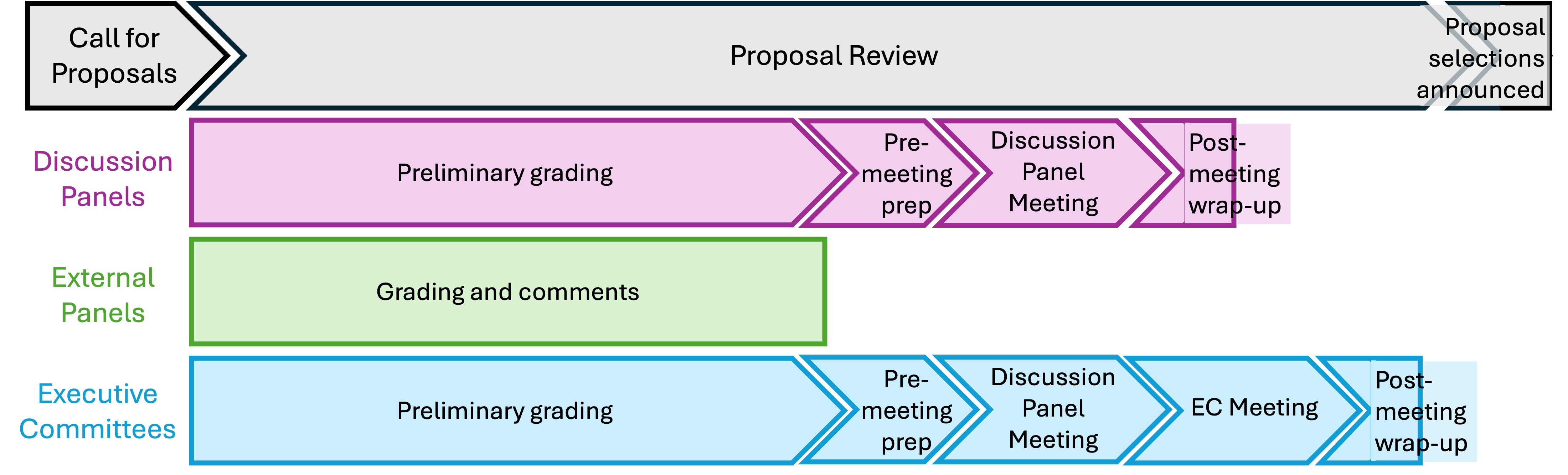
Click on the image to enlarge.
A schematic of the JWST Peer Review timeline.
External Panels
Each External Panel is comprised of External Panelists and is assigned a Panel Support Scientist (PSS) and a SPD Panel Manager. Details on the roles and responsibilities of those positions can be found on the linked pages.
The External Panels assess and grade:
- all Very Small GO (≤20 hours) proposals;
- Small GO (>20 and ≤50 hours) proposals in all science categories except Solar System Astronomy and Interstellar Gas and Dust;
- all regular AR proposals.
Discussion Panels
Each Discussion Panel is comprised of Discussion Panelists, a panel Chair, and a panel Vice Chair. Each panel is also assigned a Panel Support Scientist (PSS) and a SPD Panel Manager. Details on the roles and responsibilities of those positions, and other Observers, can be found on the linked pages.
The Discussion Panels assess and grade:
- Small GO (>20 and ≤50 hours) proposals in the Solar System Astronomy and Interstellar Gas and Dust science categories;
- all Medium GO (>50 and ≤130 hours) proposals;
- all Target of Opportunity (ToO) proposals, regardless of size;
- all Survey proposals, regardless of size.
Information about the stages of the Discussion Panel Meeting can be found on the pages within the Discussion Panel Meetings section.
Executive Committee
Each of the two ECs is comprised of the Chairs and Vice Chairs of the corresponding Discussion Panels and At Large Members. Each EC is "chaired" by one of the two TAC Chairs. They are assigned a Panel Support Scientist (PSS) during the EC Meeting, which is also attended by various SPD members and Observers.
The Executive Committees assess and grade:
- all Large GO (>130 hours) proposals;
- all Treasury GO proposals, regardless of size;
- all Pure Parallel proposals, regardless of size;
- all Legacy AR proposals.
The stages of the Executive Committee meeting are similar to the Discussion Panel Meetings and can be found in the Discussion Panel Meetings and Executive Committee Meetings pages.
Next: Guide for External Panelists