NIRSpec IFU Known Issues
Known issues specific to NIRSpec IFU data processing in the JWST Science Calibration Pipeline are described in this article. This is not intended as a how-to guide or as full documentation of individual pipeline steps, but rather to give a scientist-level overview of issues that users should be aware of for their science.
On this page
Specific artifacts are described in the Artifacts section below. Guidance on using the pipeline data products is provided in the Pipeline Notes section along with a summary of some common issues and workarounds in the summary section.
Please also refer to NIRSpec IFU Calibration Status for an overview of the current astrometric, photometric, and wavelength calibration accuracy of NIRSpec IFU data products.
Artifacts
Cube building resampling artifacts
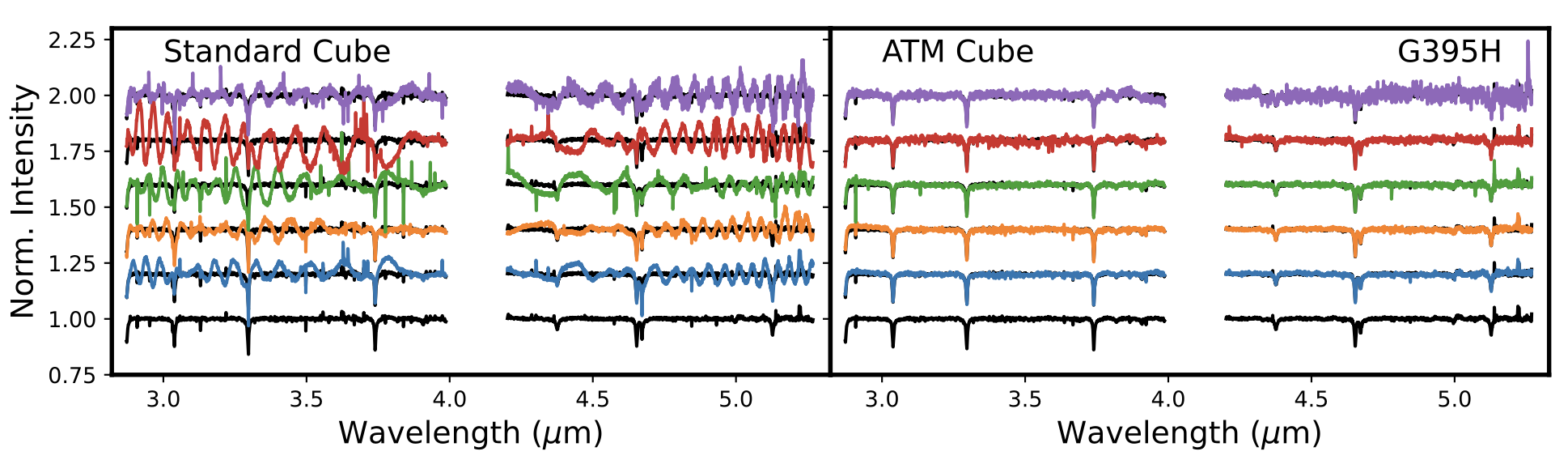
The NIRSpec IFU PSF is spatially under-sampled by the NIRSpec detector pixels, which can lead to pixel aliasing effects when resampling observed data during cube building. When in the vicinity of unresolved point sources this results in "ringing" or oscillations in the spectra of individual spaxels or in the spectra extracted from regions that are small relative to the FWHM of the NIRSpec PSF (Law et al. 2023). An example of this is shown in Figure 1 (Law & Clarke 2026). As of JWST pipeline v2.0.0 (and later versions) there is an optional pipeline step, the adaptive_trace_model step, that can be used to greatly reduce these resampling artifacts in IFU cube data as can be seen in the right-hand of Figure 1. The NIRSpec IFU pipeline notebook shows how this step can be run as part of pipeline processing.
More information about these undersampling effects and how to correct them can be found on the Resampling Artifacts page. The adaptive_trace_model step is described in more detail in the JWST pipeline ReadTheDocs and in Law & Clarke (2026).
Figure 1. An example of cube building resampling artifacts and correcting them with adaptive trace modeling.
Click on the figure for a larger view
Normalized JWST/NIRSpec G395H/F290LP spectra of standard star J1743045 (spectral type A5 IIIm) measured from an IFU cube (modified from Figure 6 in Law & Clarke 2026). The solid black lines show the aperture-integrated spectrum of the source in the cube, while the colored lines show spectra from individual spaxels in increasing brightness from purple (top) to blue (second to the bottom). (Left) spectra extracted from a standard IFU cube, demonstrating resampling artifacts that appear as oscillations in the spectra that change from spaxel-to-spaxel. (Right) spectra extracted from an IFU cube that has been built using the adaptive_trace_model step (ATM) to oversample 2-D detector data prior to cube building. Use of this step can greatly reduce the oscillating resampling artifacts.
Pipeline notes
The topics below affect imaging observations and reflect common questions about how to improve the quality of the data from the pipeline. For issues that affect all observing modes, see NIRSpec Known Issues.
Cube building
The cube_build step of the pipeline combines the individual 2-D IFU slice images and creates a 3-D spectral cube. The IFU cubes are, by default, constructed with north pointing up and east to the left. Cube building can be done using either the default 3-D drizzle algorithm, or alternatively, the Shepard's method of weighting. The current pipeline default setting is the 3-D drizzle algorithm.
- To use 3-D drizzle, set weighting = drizzle
- To use Shepard's method with exponential or linear weighting, set weighting = emsm or msm
It is sometimes useful to build a cube in the detector frame (for example, when analyzing the point spread function), rather than in sky coordinates. To build the cube in detector coordinates:
Set coord_system = ifualign
The default cube building uses a linear wavelength sampling. The NIRSpec PRISM in particular has a non-linear wavelength solution, however, so the linear sampling oversample some wavelengths and can lead to strong resampling artifacts in the PRISM cubes. As of jwst pipeline version v2.0.0 (and onwards) NIRSpec IFU cubes can be built with the option linear_wave = False to use a more natural, non-linear wavelength sampling. The examples below show how to access the wavelength arrays of non-linearly sampled cubes:
cube_file = 'my_nonlinear_cube_s3d.fits'

# when importing the cube using astropy.io fits:
from astropy.io import fits
cube = fits.open(cube_file)
wavelength_array = cube['WCS-TABLE'].data['wavelength'][0]

# or when opening the cube using jwst datamodels:
from jwst import datamodels
cube = datamodels.open(cube_file)
wavelength_array = cube.wavetable['wavelength'][0]
Correlated 1/f read noise
The effects of 1/f noise for NIRSpec MOS are shown in the IFU 1/f noise cleaning notebook, which also demonstrates the use of the NSClean algorithm to remove most of this effect. NSClean is implemented in the pipeline versions from v1.13.4 through v1.20.2 as a non-default option. As of jwst pipeline v2.0.0 (and later versions) there are multiple 1/f cleaning options provided by the optional clean_flicker_noise step available in both calwebb_detector1 and calwebb_spec2. The IFU pipeline notebook shows how this step can be run as part of pipeline processing.
Background subtraction
ReadTheDocs documentation: Background Subtraction
Background subtraction is automatically applied by the calwebb_spec2 pipeline for nodded observations or observations with dedicated background or leakage observations. It is not automatically applied for observations that have off-scene background observations that were not linked to the target in APT. Custom background subtraction may be required depending on science use case. In particular, a 1-D master background spectrum may be specified when running the calwebb_spec3 pipeline. A notebook is currently under construction to demonstrate this workaround.
Leakage of flux through the MSA may be significant in the case of bright extended targets or point sources in stuck-open shutters. If dedicated leakage observations were obtained at every dither or nod, the pipeline will use them to subtract the leakage signal. If leakage observations were only acquired at one dither or nod, the pipeline will use that leakage observation for all dither/nod positions. If the leakage changes significantly with dither/nod position and only a single leakage observation was taken, the pipeline may not process the data correctly. In this case, custom background subtraction may be necessary.
Outliers due to failed-open MSA shutters
See also: Leakage of flux through the MSA
The NIRSpec IFU and micro-shutter assembly both illuminate a common area on the NIRSpec detectors. Leakage of light through the MSA, either in the form of bright sources leaking through closed shutters or light (from the sky or other sources) illuminating failed-open shutters, can contaminate IFU exposures. If dedicated leakage observations, called "leakcals" or "imprints", are not taken and subtracted from IFU exposures, then this contamination can appear as outliers in IFU cubes. These outliers are most commonly due to failed-open MSA shutters, because they are always illuminated by the sky. Figure 2 shows an example of IFU cubes that have apparent outliers due to failed-open MSA shutters. In level 2 cubes from processing individual exposures, the failed-open shutters have a fixed pattern in the cubes. In the combined level 3 cube, combining dithers results in a more complex pattern of outliers from the failed-open shutters.
Figure 2. IFU outliers due to MSA open shutter contamination
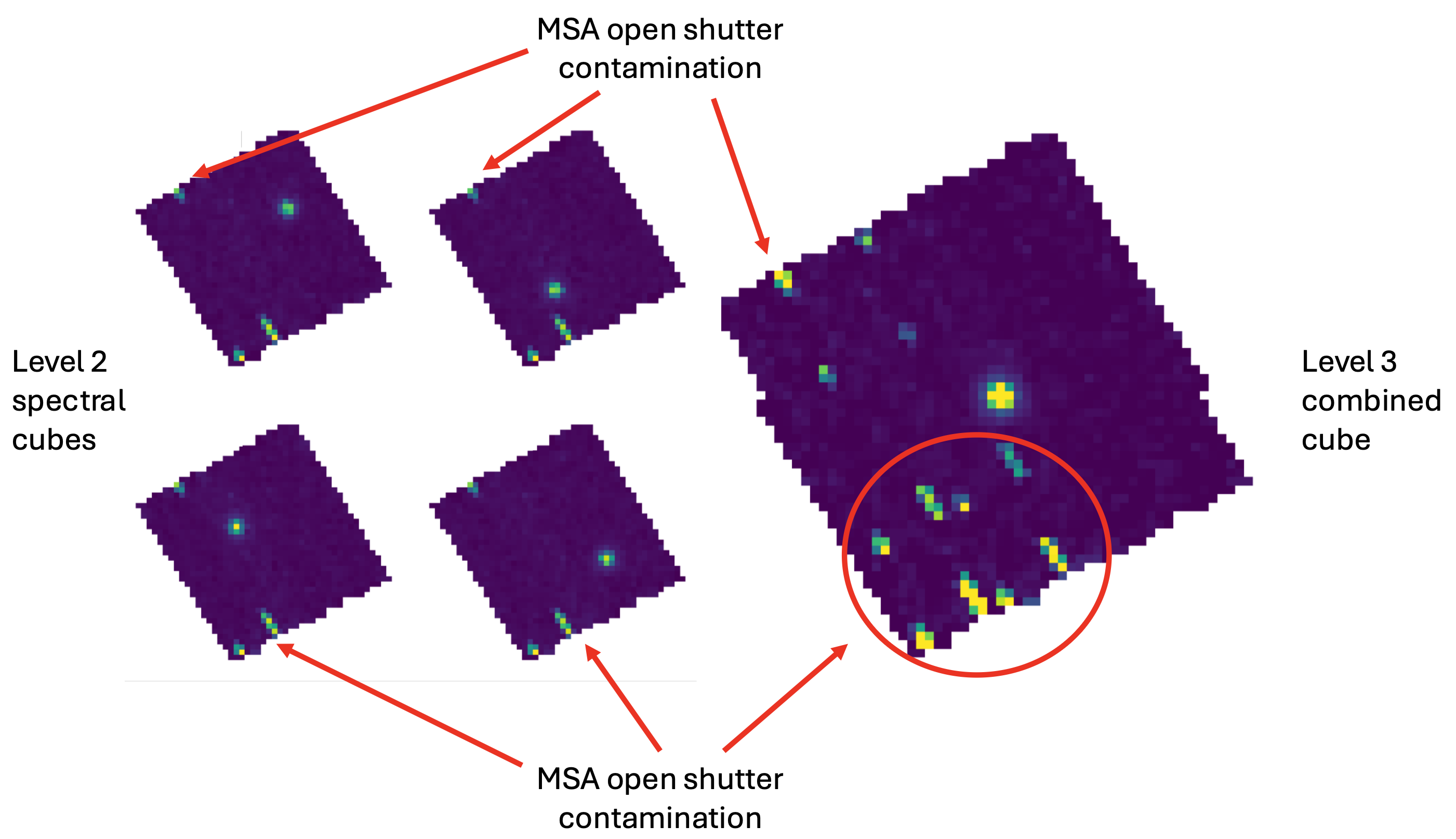
Images of spectral cubes from the NIRSpec IFU observation of a high redshift quasar, J2239+0207, in GTO program PID 1205 observation 11. (Left) A set of four level 2 cubes from each of the exposures of the source taken in a 4-point large dither cycling pattern. The source appears in different locations in each cube due to the dithering, but contamination (of sky spectra) from open MSA shutters appears at a fixed position in each of the cubes. (Right) The level 3 cube for this source spatially aligns the source and combines each of the individual dithers, causing MSA open shutter contamination to appear as a spatial pattern of outliers.
Contamination from failed-open shutters can be removed by taking and subtracting dedicated leakage observations, which, if necessary, should be specified when the observations are proposed. By default the calwebb_spec2 pipeline runs the msaflagopen step, which flags pixels that are expected to be illuminated by known failed-open shutters (recorded in a "msaoper" reference file) with the "MSA_FAILED_OPEN" bit flag. While these flags are only qualitative and do not mask data by default, if leakage observations are not taken, contamination from failed-open shutters can be partially mitigated by manually setting any flagged pixels to NaN values. If flagging this contamination is needed, it is best done by updating all "cal" files prior to calwebb_spec3 processing, so that only uncontaminated pixels are used for building dither-combined level 3 cubes. The code sample below shows how to flag these contaminated pixels in a list of exposures. Once all files have been updated, if they have been saved to new filenames, users should also update their level 3 associations to use the new filenames before running calwebb_spec3. Note: the leakage spectrum can extend beyond the wavelength range formally flagged by the pipeline with the "MSA_FAILED_OPEN" bit flag and may require visual investigation of the 2-D spectra and additional manual flagging of contaminated pixels.
import numpy as np
from jwst import datamodels
from jwst.datamodels.dqflags import pixel as flags

list_of_files = ['<file1>', '<file2>', '<file3>', '...']

for filename in list_of_files:
    # you can also use the same input filename as the output if you want to overwrite the file
    output_name = filename.replace('.fits', '_mod.fits')

    model = datamodels.open(filename)
    dq_array = model.dq

    # Find MSA_FAILED_OPEN pixels
    msa_open_pixels = (dq_array & flags["MSA_FAILED_OPEN"]).astype(bool)

    # Set such pixels to NaN and save to an output file
    model.data[msa_open_pixels] = np.nan
    model.save(output_name)
Outliers in background and leakcal subtracted data
NIRSpec IFU data can feature more outliers if using the default pipeline processing when nods, dedicated background exposures, or leakage exposures are subtracted. These outliers are often due to new or changing hot pixels that are not flagged by the bad pixel mask. The outlier_detection step in calwebb_spec3 is designed to identify outliers that are consistently bad in multiple exposures, such as hot pixels. However, if nod/background/leakcal subtraction is performed, the subtraction of a hot pixel often leaves large poisson noise that differs between exposures. This large poisson noise, itself, can cause a pixel to appear as an outlier, however, because it changes significantly between exposures, these outliers can be missed by the outlier_detection step and show up in the final level 3 IFU cubes.
The JWST pipeline includes an optional step, badpix_selfcal, in calwebb_spec2, which can be used to flag these hot pixels (and other bad pixels) prior to background and leakcal subtraction, reducing the number of outliers that show up in the final IFU cubes. To run the badpix_selfcal step, the calwebb_spec2 step must be run on an association listing all of the relevant exposures (e.g., the science, background and/or leakcal exposures) as "selfcal" members in the association and the badpix_selfcal parameter skip = False must be set. Note that when adding selfcal exposures to an association some exposures would show up twice in the association, once as a "science," "background," or "imprint" member and once as a "selfcal" member. More information on the badpix_selfcal step can be found on the Bad Pixel Self-Calibration ReadTheDocs page, and examples of setting up the requisite association files programmatically can be found in the NIRSpec IFU pipeline notebook.
Spectral and spatial distortions
For more information see Beck (2025).
Distortions have been seen in the spatial location of the PSF centroid as a function of wavelength and the spectral centroid of emission lines:
(i) Point sources in the NIRSpec IFU have been seen to wander in x/y positions by up to 0.3–0.4 pixels (as shown in Figure 2). This appears to be due to a chromatic effect of the NIRSpec fore-optics that is not accounted for in the NIRSpec instrument model and is therefore common to all NIRSpec filters/dispersers (T. Beck, JWST Technical Report, in prep.). As of of jwst pipeline v3.0.0 (and later versions) the NIRSpec instrument model has been updated to include a fore-optics chromaticity correction, "chromcorr," reference file that is designed to correct this wavelength dependent PSF centroid wander in the NIRSpec IFU. This reference file is used in the assign_wcs step during calwebb_spec2 processing, where corrections are added to the WCS transforms, so that corrections are automatically incorporated in pipeline processing and building spectral cubes. These chromaticity corrections reduce the wavelength dependent source centroid drift from up to ~35 mas (0.35 pixels) down to ~5 max (0.05 pixels) across all filters/gratings (C. Hayes, JWST Technical Report, in prep).
Figure 3. Spatial distortion of PSF.

The x and y position of the PSF from 2-D Gaussian fits as a function of wavelength for the NIRSpec IFU observation of the (point source) planetary nebula IRAS 05248-7007 using the PRISM+CLEAR disperser/filter combination. Each panel shows a different dither observation, combined here for illustration purposes. The color bar to the left shows the wavelengths of the measured x and y positions from 1 to 5 µm. In this view, the cross-slice direction goes from bottom to top, while the right-left direction is the axis along the IFU slices. Hence, the larger shift in the x pixel direction shows that the PSF centroid is predominantly varying within a slice, and the y shift in centroid position across slices is small and less than one slice width. Credit: Beck (2025).
(ii) Gaussian line-fit kinematic analysis of compact emission lines are showing a blue/red shifted character across slices at the 1–1.5 pixel level, as demonstrated in Figure 3. The shift is seen across the NIRSpec IFU slices, with similar shift in pixel magnitude regardless of disperser used. This effect appears to be due to uneven slice illumination effects (T. Beck JWST Technical Report, in prep.). Gradients in the illumination along the dispersion direction of a given IFU slice mean that light will be weighted towards one edge of the slice. When imaged on the detector spatial gradients along the dispersion direction of the slice are degenerate with wavelength shifts of the light and can, therefore, result in apparent kinematic shifts across sources with steep light profiles (such as the PSF of unresolved sources). The kinematic analyses of all spatially resolved emission line sources with compact morphologies can be affected at this level.
Figure 4. Spectral shift in emission lines.

Spectral shifts seen in the emission line data from the PRISM data analysis using the Brɑ emission line at 4.05 µm and the pipeline default cube building weighting (drizzle). The panel shows 4 different dither observations combined into a single FoV for illustration purposes. Each observation shows a kinematic pixel centroid shift of nearly 1.5 pixels across the PSF position from the upper left (blue shifted centroids) to the lower right (red shifted centroids). It should be noted that the maximum expected velocity and kinematic shift from this PN should have been well below NIRSpec instrument sensitivities. Credit: Beck (2025).
These issues with the NIRSpec spatial PSF wander and spectral shifts point toward a non-trivial problem in the calibration of the NIRSpec IFU instrument model, particularly the portion of the model that anchors the internal instrument model to the RA, Dec, wavelength mapping on the sky. While these issues occur independent of the filter/disperser that is used, it has been established that these issues can have a different character depending on disperser mode used, and are not related to the cube building algorithm in the pipeline. Both issues are currently under investigation via spatial and spectral IFU distortion calibration programs (PID 6641 and 6640, respectively). STScI is investigating these issues and more information will be available in an upcoming JWST Technical Report, T. Beck (in prep). Mitigation plans will be released to the community once potential solutions have been identified.
Summary of common issues and workarounds
The sections above provide detail on each of the known issues affecting NIRSpec IFU data; the table below summarizes some of the most likely issues users may encounter along with any workarounds, if available. Note that greyed-out issues have been retired, and are fixed as of the indicated pipeline build.
| Symptoms | Cause | Workaround | Fix build | Mitigation Plan |
|---|---|---|---|---|
| NS-IFU05: Spectra extracted from single spaxels on/near point sources show a sinusoidal modulation. | NIRSpec is undersampled, and distortion causes spectral traces (particularly for the gratings) to be curved on the detector. Resampling the raw data to a rectified data cube introduces artifacts (e.g., oscillations) if extracting spectra from individual spaxels or on scales smaller than the PSF. See detailed discussion by Law et al. 2023. | As of jwst 2.0.0 (and later versions), the JWST pipeline includes an optional step in calwebb_spec2 and calwebb_spec3, called adaptive_trace_model, that oversamples 2D detector data prior to cube building, which can greatly reduce resampling artifacts in IFU cubes. The JWST pipeline notebook for IFU provides examples of how to turn on the adaptive_trace_model step in calwebb_spec3 when reprocessing data. More information about these undersampling effects and how to correct them can be found on the Resampling Artifacts page, and the adaptive_trace_model step is described in more detail in Law & Clarke (2026). | N/A | Updated issue As of jwst 2.0.0 (and later versions), the adaptive_trace_model step can reduce resampling artifacts in IFU cubes. Investigations are needed to determine whether this step could be turned on by default in the pipeline. |
NS-IFU07: The spectral centroid of emission lines shows unexpected structure across IFU slices. | Issue appears to be due to uneven slice illumination effects where light gradients across the dispersion direction of a given slice are degenerate with wavelength shifts when imaged onto a 2D detector. More information will be provided in an upcoming JWST Technical Report (T. Beck, in prep.). | None at present. | N/A | Updated issue The root cause of this issue is has been identified. Investigations into potential mitigation plans are ongoing. |
Retired Issues:
| Symptoms | Cause | Workaround | Fix Build | Mitigation Plan |
|---|---|---|---|---|
| NS-IFU01: There is a hole at the peak of the PSF or an otherwise distorted PSF in IFU "s3d" cube. | This is due to overly aggressive outlier detection. | Option 1: Turn off outlier rejection in the cube_build step of calwebb_spec3. However, this may allow other outliers to remain in the cube. Option 2: Reprocess data using the Science Calibration Pipeline, jwst 1.11.3 and onward. This version will be installed in the Operations Pipeline with build 9.3), planned for installation on . | Updated Operations Pipeline The outlier detection algorithm was updated. STScI reprocessed affected data products with an updated Operations Pipeline that was installed on August 24, 2023. (Reprocessing of affected data typically takes 2–4 weeks after the update.) | |
| NS-IFU02: Flux is not conserved in 1-D-extracted spectra of point sources when using a different output spaxel sampling. | The cube_build algorithm was designed to conserve flux assuming input units of surface brightness. However, the NIRSpec point source calibration produces units of flux density, which is not compatible. | If using data processed with the current Operations Pipeline build, do the following:
Otherwise, install the release candidate for the coming Operations Pipeline (jwst 1.11.3 and onward) and re-run calwebb_spec2. | Updated Operations Pipeline Point source calibration for IFU data was changed to surface brightness units, and 1-D spectra converted back to flux density. STScI reprocessed affected data products with an updated Operations Pipeline that was installed on August 24, 2023. (Reprocessing of affected data typically takes 2–4 weeks after the update.) | |
| NS-IFU03: Negative and/or surplus flux in the extracted 1-D spectra is seen, typically with an irregular wavelength-dependent undulation. | Correlated noise from low-level detector thermal instabilities, seen as vertical banding in 2-D count rate images, particularly in exposures of the NRS2 detector. While the IRS2 readout modes reduces this effect, it is not completely eliminated. | Run the NSClean script developed by B. Rauscher on count rate images, using an appropriate mask. (Rauscher, B. 2023, arXiv:2306.03250) A notebook demonstrating the use of the NSClean algorithm is now available. | Updated workaround notebook link NSClean was implemented in the pipeline (v1.13.4 onwards) as a non-default option. Details on how to invoke NSClean within the science calibration pipeline are provided in the workaround notebook. | |
| NS-IFU04: There is missing flux in the "x1d" spectrum of point sources. | Astrometric or pointing uncertainty may cause the default extraction aperture to miss the intended target or be off-center. | Option 1: Rerun the extract_1d pipeline step in calwebb_spec3 at specified coordinates. Option 2: Install the latest release of the jwst package and then run the Science Calibration Pipeline on the affected dataset. Starting in jwst 1.11.0, the extract_1d step supports setting ifu_autocen = True. | Updated issue An IFU astrometric solution was updated in July 2023, but small pointing offsets may remain. Reprocessing of affected data typically takes 2–4 weeks after the update. | |
| NS-IFU06: The centroid of point sources appears to drift by up to 0.5 pixels as a function of wavelength. | Issue due to a chromatic effect in the NIRSpec fore-optics that is not accounted for in the optical instrument model. The drift can be up to ~30 mas over the wavelength range of a given disperser. More information will be provided in an upcoming JWST Technical Report (T. Beck, in prep.). | Reprocess affected IFU data through calwebb_spec2 with jwst 3.0.0 (or later versions). | Resolved Issue jwst 3.0.0 (and later versions) adds new, "chromcorr", instrument model reference files that are used when building WCS transforms in the assign_wcs step. These transforms will automatically correct the fore-optics chromatic effects when building spectral cubes. Descriptions of these new models and their implementation will be described in an upcoming JWST Technical Report (C. Hayes, in prep.). | |
NS-IFU08: Leakcals are not properly associated in pipeline processing when there are separate leakcals for science and background exposures. | The pipeline does not check whether leakcals were taken for a background or science exposure. Additionally, when one leakcal is taken for all science dithers and a separate leakcal is taken for all background dithers the pipeline will attempt to match based on dither position which will fail to find matches for all but the first dither position. | Reprocess data through calwebb_spec2 with jwst 1.18.0 (or later versions) using calwebb_spec2 association files that include all of the appropriate leakcal exposures as "exptype" = "imprint" members. | Resolved issue. Leakcal matching in the pipeline and association file generation has been fixed as of jwst 1.18.0 (and later versions), and will be included in the Operations Pipeline update to be released in May 2025. Reprocessing of affected data typically takes 2–4 weeks after the update. |
References
Beck, T. 2025, JWST Technical Memorandum JWST-STScI-009029
Evidence for Problems in the JWST NIRSpec IFU Calibration Distortion Model
Law, D., et al. 2023 AJ 166, 45
A 3D Drizzle Algorithm for JWST and Practical Application to the MIRI Medium Resolution Spectrometer
Law, D. R. and Clarke, M. 2026, arXiv 2603.26916 (Adaptive Trace Model)
Mitigating Resampling Artifacts for the JWST IFU Spectrometers with Adaptive Trace Modeling